
Gideon Hermann
They/He
Edinboro, PA, US
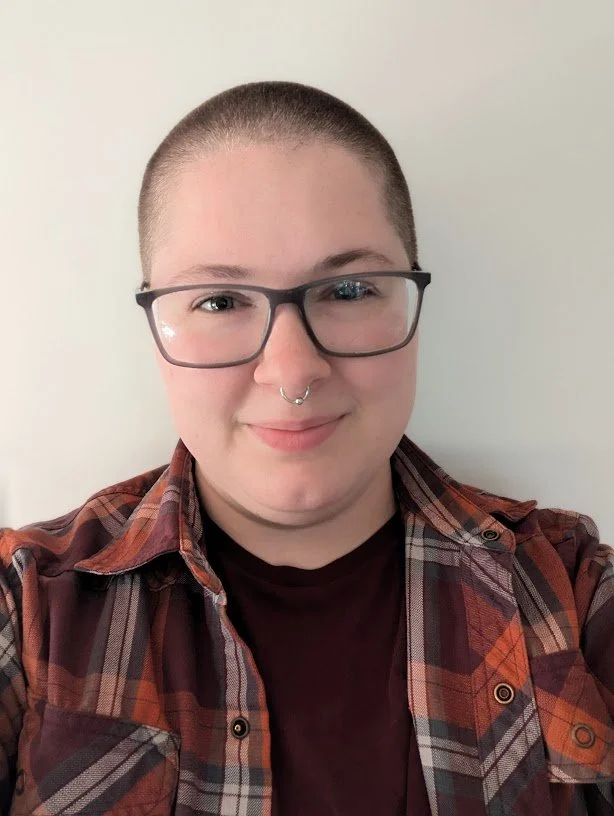
Gideon Hermann is a jeweler and metalsmith currently located in Western Pennsylvania. They are pursuing a Master of Fine Arts degree at Pennsylvania Western University, Edinboro. They received their Bachelor of Fine Arts with a focus in Jewelry and Metalsmithing and a Digital Fabrication and Design Certificate at the University of Wisconsin-Milwaukee in May 2021. Gideon’s work features intricate steel wirework and discusses the rust belt, its history, and the future of the region after de-industrialization.
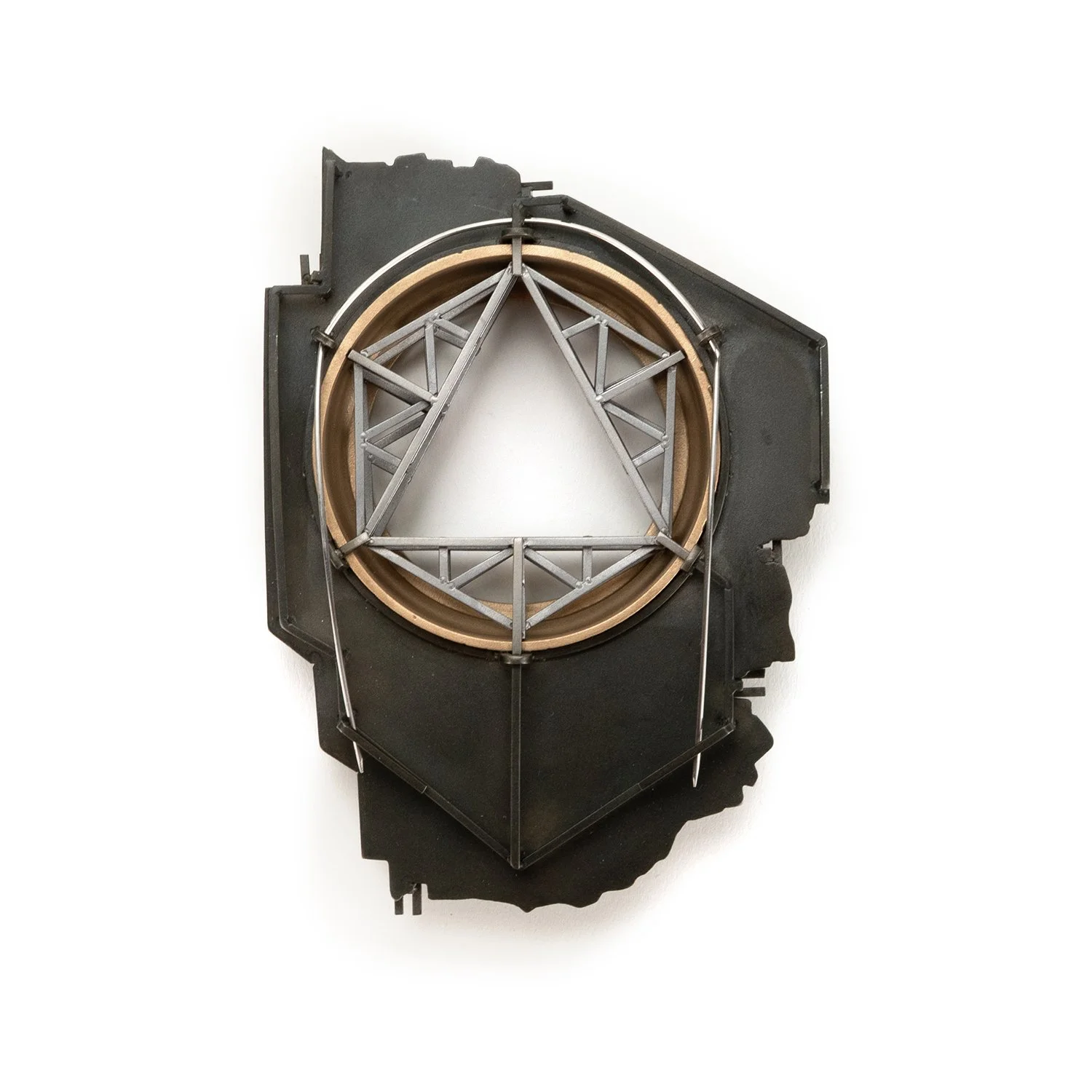
“This work reflects on my complex relationship with my father, a mechanic whose generosity, skill, and masculinity deeply shaped me. He can fix anything, and would drop everything to help me. Still, he struggles to see me as a man, and he supports politics that harm trans people. I feel both close to him, and also so distant- finding traces of him in myself even as I reject many of his beliefs. In this piece, I combined a found object from each of our lives: a brass pipe fitting from his workbench, and moss-covered wood I gathered on one of my hikes. While making this piece, I reflected on the tension in our relationship, our connections, similarities, conflicts, and differences.”
How does your work relate to the theme of flourish(ing)?
“From my father, I inherited resourcefulness, a knack for understanding how things work, a deep curiosity about the world, and a model of masculinity rooted in kindness and generosity. These traits shaped me, and they continue to sustain my creative practice. Yet flourishing, for me, also means discerning which parts of that inheritance to carry forward and which to dismantle. While I embrace his persistence and generosity, I refuse to inherit the beliefs that deny me recognition as a trans person. I refuse beliefs that put immigrants at risk, expand systems of policing and violence, or accept exploitation as inevitable. To flourish in inheritance is to reimagine it—to carry forward what nurtures me and those around me, while dismantling what causes harm. In this way, flourishing becomes not a passive continuation, but an active commitment: to growth, to care, and to creating a world where more of us can survive and thrive.
Alongside this reckoning with family, I turn to nature as another guide, especially in understanding what it means to flourish despite hardship. The weathered wood with moss included in this piece recalls camping trips with my father, but it also points to renewal, resilience, and the quiet persistence of life. Moss thrives in overlooked, difficult places such as cracks, ruins, and damp corners where little else can grow. It flourishes in adversity, adapting to what the world offers while quietly asserting its presence. As this world feels darker and more terrifying by the day, I am drawn to moss and other plants that survive and thrive in harsh conditions. They model a form of flourishing that is not dependent on ease or recognition, but on persistence, resourcefulness, and the courage to grow where others cannot. In this way, moss becomes both metaphor and mentor: a reminder that survival and growth are possible even in the most unlikely circumstances, and that life—like creativity, like identity—can take root and thrive in unexpected spaces.”
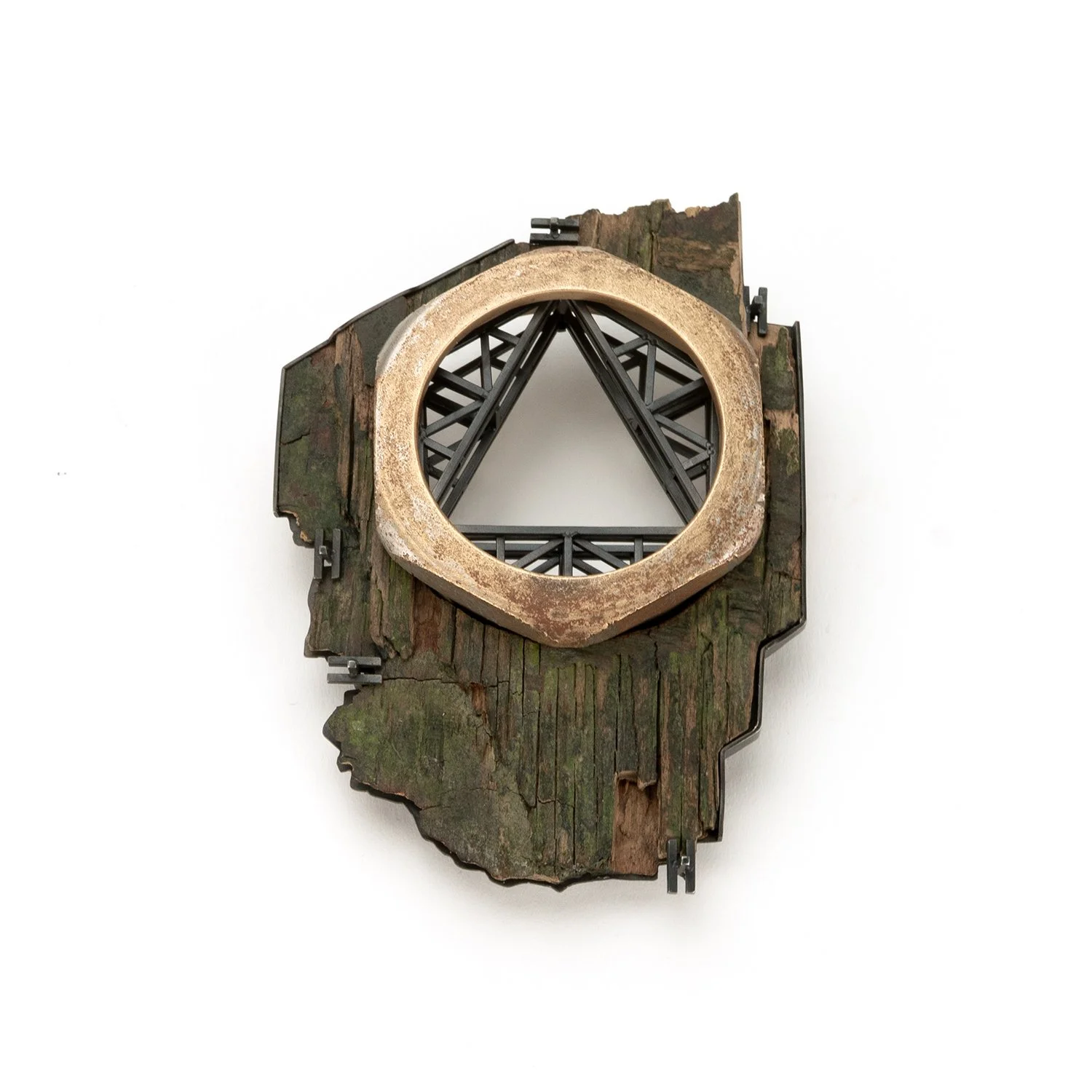
"Lessons of the Hand", Wood, brass, steel, 4" x 2.75" x .75", 2025How does your creative practice allow you to flourish (grow, thrive, blossom)?
“My creative practice allows me to flourish by providing a space to engage deeply with the world, to explore relationships, and to reflect on resilience, change, and growth. Working with materials like steel, rust, and moss mirrors life’s processes of change. I witness and participate in these processes through making, modeling ways of thriving even in challenging or unpredictable conditions. It gives me hope, and it gives me a way to process the circumstances around me.
Art-making also fuels my curiosity and connection to the world. While metalsmithing is central to my practice, it intersects with my interests in nature, geometry, science, observation, and more. Each project becomes a way to explore these areas while processing and communicating what I learn.”
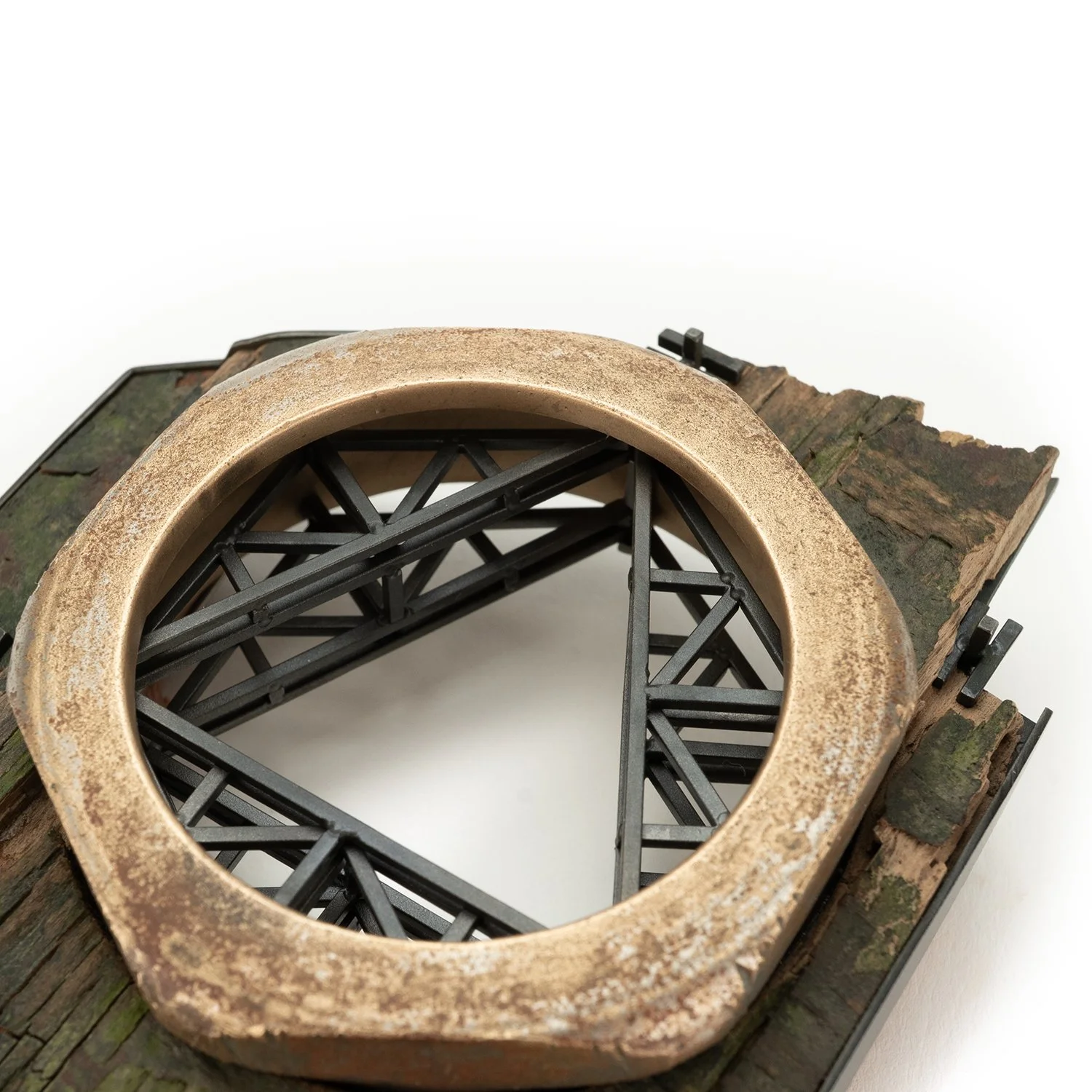
Photographs by Wren Schulz
As a queer+ artist, what would you like to see and/or what do you need in order to flourish during this time?
“Sense of community- I’m used to living in the city, and having a community of queer friends around me. I recently moved to a small town for grad school, and I deeply miss the sense of community I had in the city.
I also would really like to see more mutual aid and more practical and hands-on activism. There’s not much around me from what I’ve seen, but I would flourish in a world where I could volunteer time towards efforts like community gardens, repair days, community educational workshops, and other practical ways to engage with community.”
Anything else you would like to share about this work? This can be an important part of the process, sourcing materials, or research.
“My father makes an effort to use my chosen name, but I know he may never see me as a son, even as I find traces of his face in my own reflection since beginning HRT. Despite this distance, many of my moments of gender euphoria are tied to him: working on cars together, grease on our hands, listening as he explained how each part connected to the next. Us sitting at the kitchen table, building small electrical circuits or doing science experiments. He instilled his curiosity about the world, his ability to work with his hands, and his drive to understand how things work in me, and they’re some of my most treasured gifts. His resourcefulness and persistence were also a constant presence in my childhood, and I carry those lessons into my practice as an artist. He is one of the most generous people I know. He is willing to drop everything to help when someone he loves is in need—yet I often can’t get through an extended conversation with him without feeling isolated and misunderstood.
This piece brings together fragments from both of our lives. I incorporated a brass pipe fitting I discovered while helping him clean out my childhood home, and paired it with a piece of moss-covered wood I found on a hike, which also serves as an echo of the family camping trips that first sparked my love of the woods. Bound together with steel and structure, these objects become a contemplative space where I consider masculinity, my relationship with my father, connections and boundaries. Constructed in mild steel, the piece will inevitably rust and transform, mirroring the way my relationship with him continues to change.”