
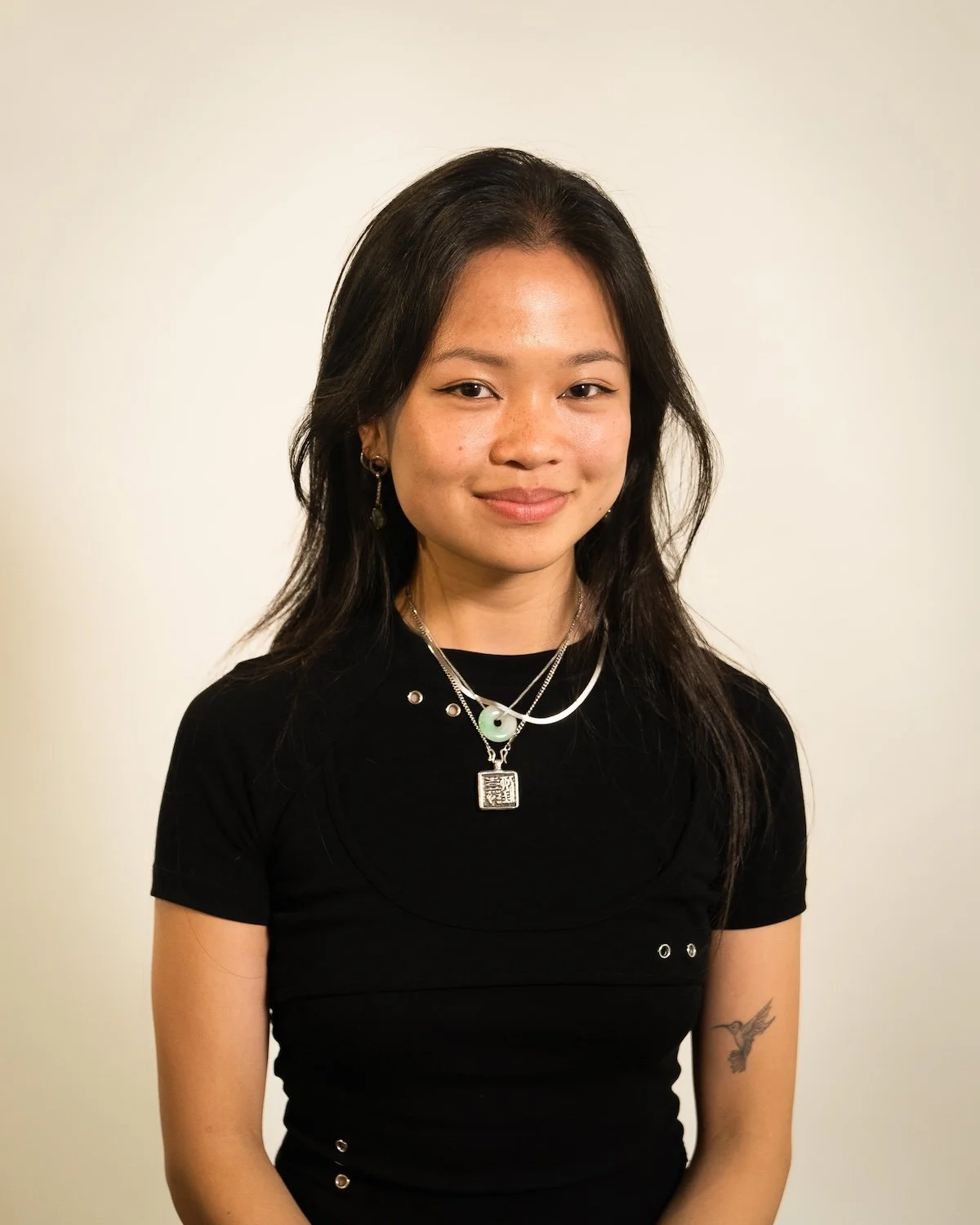
Connie Liu
She/They
San Francisco, CA, USA
“Connie Liu is a Hoisanese-American interdisciplinary artist born and raised in San Francisco. Working across metalsmithing, stonecarving, bookbinding, and oral histories, Connie explores how memory, identity, heritage, and language become embedded in material form.
They are currently a year-long jewelry artist-in-residence at The Steel Yard in Providence, RI. They have exhibited at Fort Mason Center for Arts & Culture, Gray Area, Granoff Center for the Arts, Rhode Island School of Design, List Art Center, and Brown Arts Institute, and recently completed residencies at Ma's House, First Exposures, and NowPlace.”
“My practice juxtaposes recognizable historical forms associated with prestige against speculative futures and histories imagined for communities and people that have long been denied inheritances, whether of material wealth, cultural memory, or historical recognition. Particularly through the study of emblems and seals such as signet rings, jewelry historically used to assert lineage, authority, and belonging, I ask what new roles these objects might assume in restoring and remembering those that have been written out of the record, such as my family’s matriarchs and my family’s dying mother tongue. What forms can a self-determined identity take, and what can it mean to create my family’s first heirloom?”
@theliuvre
How does your work relate to the theme of restoration?

“My ring “Unearthing My Mother at the Altar” was the first time I incorporated my mother’s maiden name into my work, despite having spent years making signet rings and jewelry that engage with family narratives. In constructing heirlooms and speculative artifacts for my family’s history, I had always placed my own last name (the same as my father’s) at the center of the ring.
Yet growing up, it was my mother and her side of the family who held the entire family together. She handled immigration paperwork, helped my father’s family settle in America, and worked to ensure that all of the children remained in school. One evening, while arguing with my father about the burdens she carried on behalf of his family, my mother turned to me and asked, “What is the value of Liu?” Her question confronted me with the realization that my attempts to preserve our family history had, until then, represented almost exclusively my father’s lineage.
I began to question the very practice I had found myself engaged in: the preservation of lineage, family history, and legacy. Historically, these systems have privileged patrilineal narratives, including the names, inheritance, and legacies of men, while often obscuring the women whose labor sustains families. There is no mention of the culture-bearing, child-rearing, caregiving, and other invisible work that allows those male legacies to exist in the first place.
This bi-metal signet ring was my first attempt to intervene in that tradition and restore my mother’s name to the narrative and memorialize her side of the family alongside my father’s. There is still an irony, however, that even my mother’s maiden name ultimately belongs to her father. Patrilineal structures are so deeply embedded in the very names through which we attempt to recover women’s histories.
“Unearthing My Mother at the Altar” is both an act of restoration and a recognition of what remains unresolved. It is an attempt to place my mother’s role within my family’s history and to understand myself not simply as an extension of my father’s lineage, but as a convergence of both of my parents’ families.”
"Unearthing My Mother at the Altar Right" Connie LiuHow does your creative practice allow you to restore (renew, return, reclaim, recover)?
“My creative practice centers on working through family history and lineage, recovering histories that have been forgotten, and preserving them through materially enduring forms such as metal and stone. Working with these materials allows me to participate in the creation and documentation of history while also imagining ways of rewriting it. I seek to restore the histories of my family’s matriarchs and queer ancestors, honoring the love and labor of the women who shaped my family, while creating avenues for overlooked and smaller communities to have their histories recognized, preserved, and carried forward.
Beyond jewelry, I'm deeply involved with the San Francisco Chinatown community and bring my dying mother tongue and the local histories of my family’s town in China into greater visibility through dictionary zines and language meetups (the first of their kind for the language). These gatherings create spaces for people to rediscover their connections to the town and its language, while bridging generational gaps in language, memory, and cultural knowledge. I am always working with the past, and trying to bring and bridge those narratives into the present and the future.”


As a queer+, artist, what do you see can be, needs to be, or cannot be restored?
“As a queer artist, something I hope can be restored, within myself and for other queer people, is a more confident sense of place and belonging within the communities we come from. Despite growing up in a very liberal city and choosing to inhabit primarily queer spaces, I find myself constantly codeswitching between communities: from city to city, and especially between the queer chosen community of my adult life and the more closed-minded familial community of aging Chinese relatives. I don’t believe full recognition can be restored in my own personal life; I have learned to choose which battles to fight and where to find middle grounds of understanding with grandparents and relatives who have little conception of what queerness is. Still, I hope that the discomfort, second-guessing, and sense of otherness I experience within a community whose histories I have spent so much of my life preserving might eventually give way to a willingness to care about my future as deeply as I care about our past.”
Photographs Courtesy of the Artist