
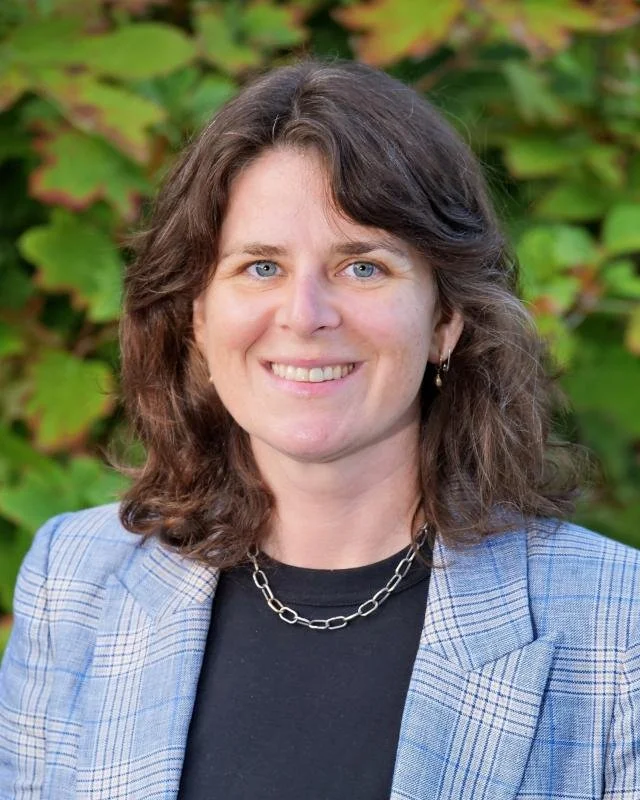
Elisabeth Arzt
She/They
Adamstown, MD, USA
“Elisabeth Arzt is a Maryland-based multidisciplinary artist and founder of Fine Arzt Studio. Raised on a Western Maryland farm, she developed a lasting reverence for nature that continues to ground her work. With a BFA in sculpture from the Corcoran College of Art + Design, Elisabeth’s practice spans monumental chainsaw carvings to finely wrought jewelry, blending woodworking and metalsmithing to honor material, memory, and transformation. Sustainability is central—she crafts with recycled sterling silver, salvaged wood, and ethically sourced stones, creating heirlooms that connect past and present. Each piece reflects her fascination with time, history, and story, from wood rings that carry nature’s rhythms to metals endlessly melted and reimagined. Elisabeth’s work has been exhibited at the Corcoran Gallery of Art, Smithsonian Craft Week, Strathmore Mansion, and Tephra Institute of Contemporary Art, and belongs to private collections in the U.S. and abroad.”
“My work explores memory, time, and transformation through jewelry and sculpture. Using recycled sterling silver, 14k gold, salvaged wood, and ethically sourced stones, I create pieces that honor material and story. Rings of wood echo nature’s role as a timekeeper, while silver and gold—melted and reshaped countless times—carry the imprint of many hands. Each piece is both adornment and talisman, a reminder that what we carry connects us to history, place, and one another. Rooted in sustainability and craft, my practice seeks to preserve memory while offering new forms of beauty.”
finearzt.com
@fineArzt
How does your work relate to the theme of restoration?
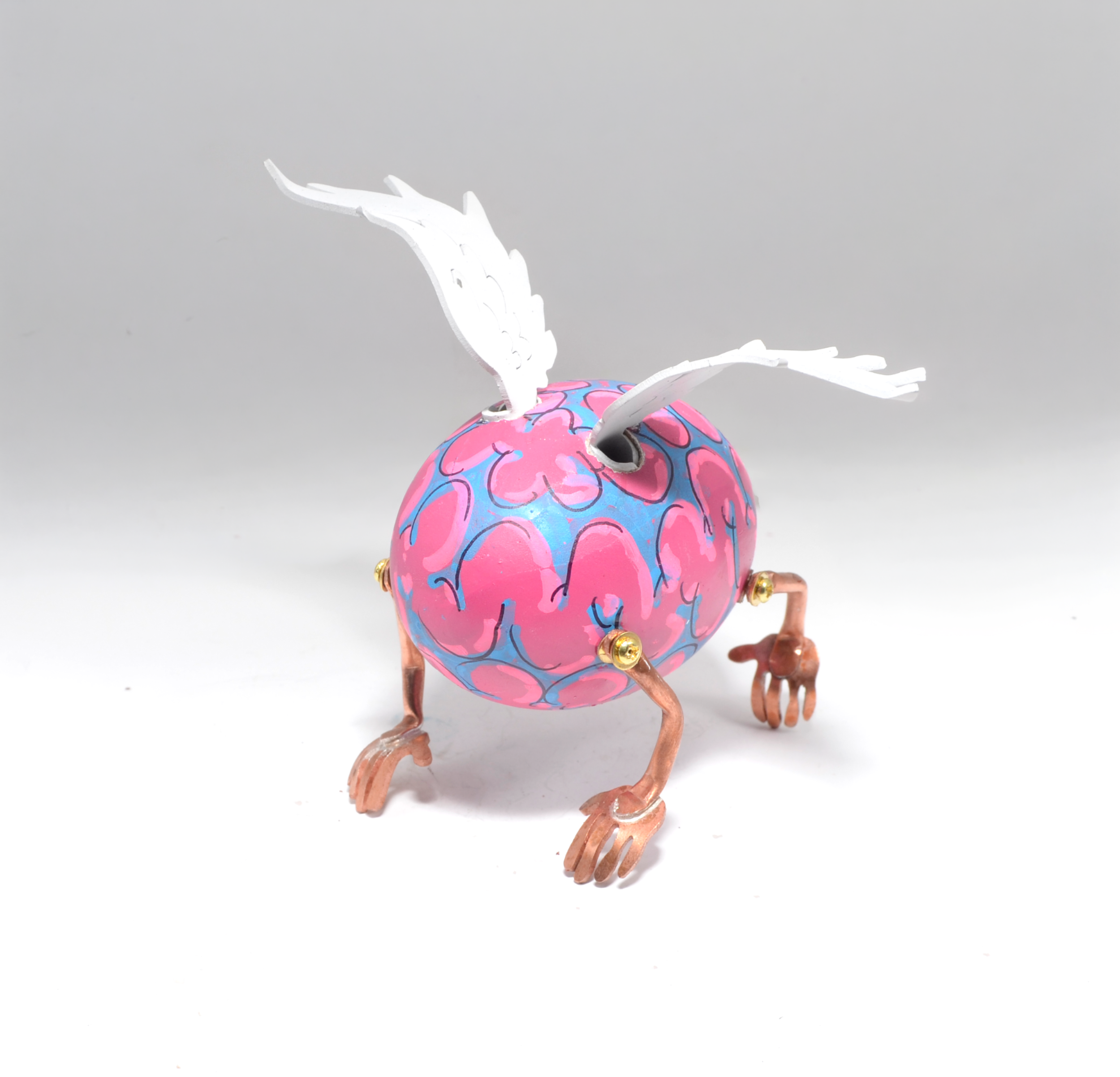
“Primordial Egg reimagines the ancient Chinese figure Dijiang/Hundun—the primordial being representing the universe before order, when celestial and terrestrial forces existed together in an enclosed, formless chaos. In ancient descriptions, Dijiang has no face, eyes, or mouth. It is not yet defined.
I am interested in that state of being undefined—not as a lack, but as a space of possibility.
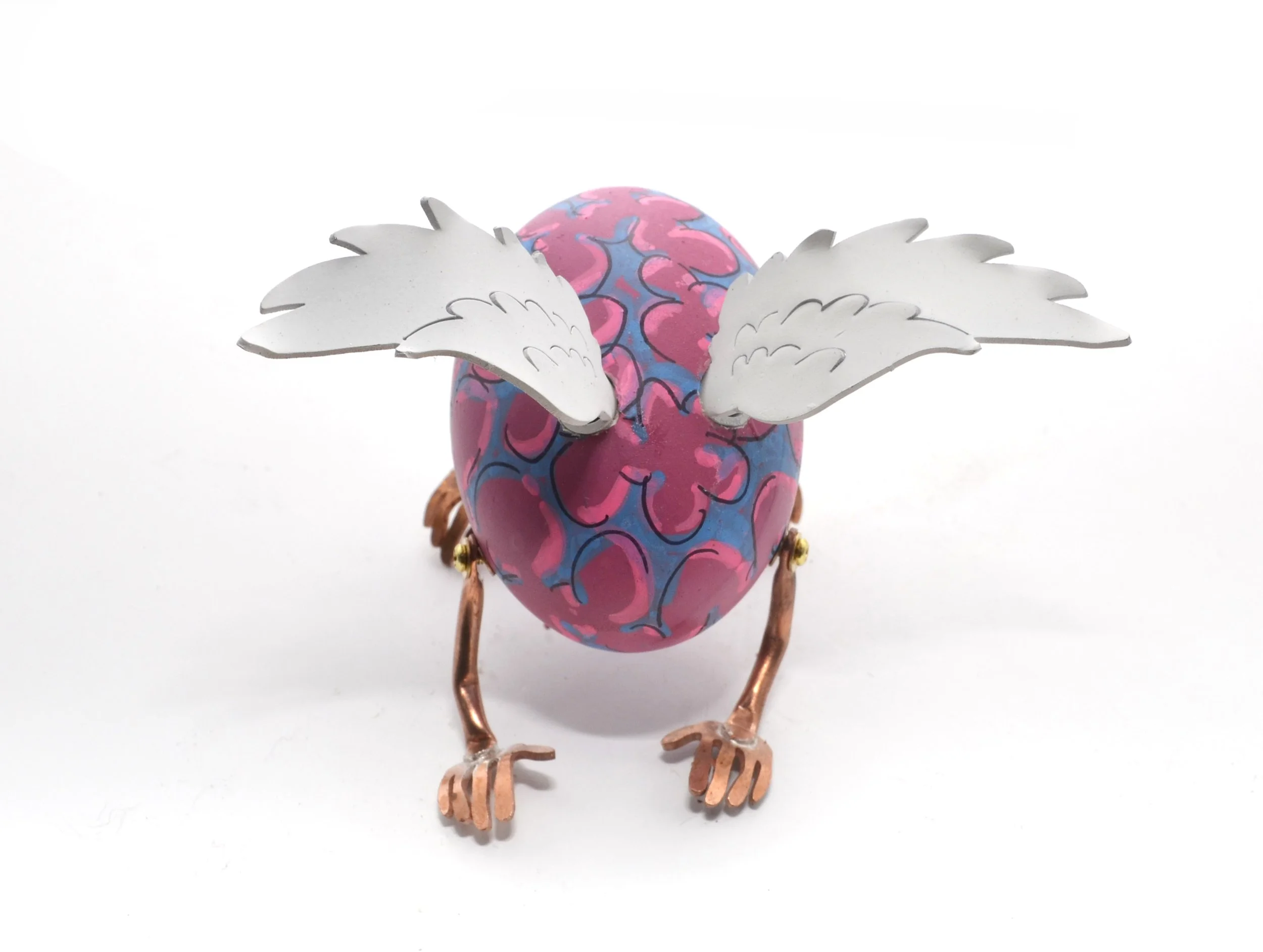
My wooden eggs transform this primordial creature into brightly painted, tactile beings with four articulated arms, long expressive fingers, and a pair of white wings. The brain-like patterns reference both the complexity of an emerging consciousness and the decorative language of pysanka eggs, objects traditionally associated with cycles of life, renewal, and transformation. The movable arms invite interaction: the viewer can pick up the creature, pose it, make it gesture, or imagine it responding.
For me, restoration is not necessarily about returning something to its original form. It can mean reclaiming the freedom to become something new.
The Primordial Eggs exist in that in-between state. They are playful and colorful, but their elongated fingers and unfamiliar anatomy introduce something uncanny. They can feel like toys, relics, creatures, or tiny gods. Their ambiguity is intentional. Rather than asking the viewer to define them, I want them to remain open—capable of changing through interaction and imagination.
In the context of queerphoria: restoration, the egg becomes a metaphor for self-creation: a contained world holding possibilities that have not yet taken a prescribed shape. Restoration becomes an act of making space for the undefined, the evolving, and the wonderfully strange. These creatures do not need to return to an original form. They are allowed to become.”
"Primordial Egg" Elisabeth Arzt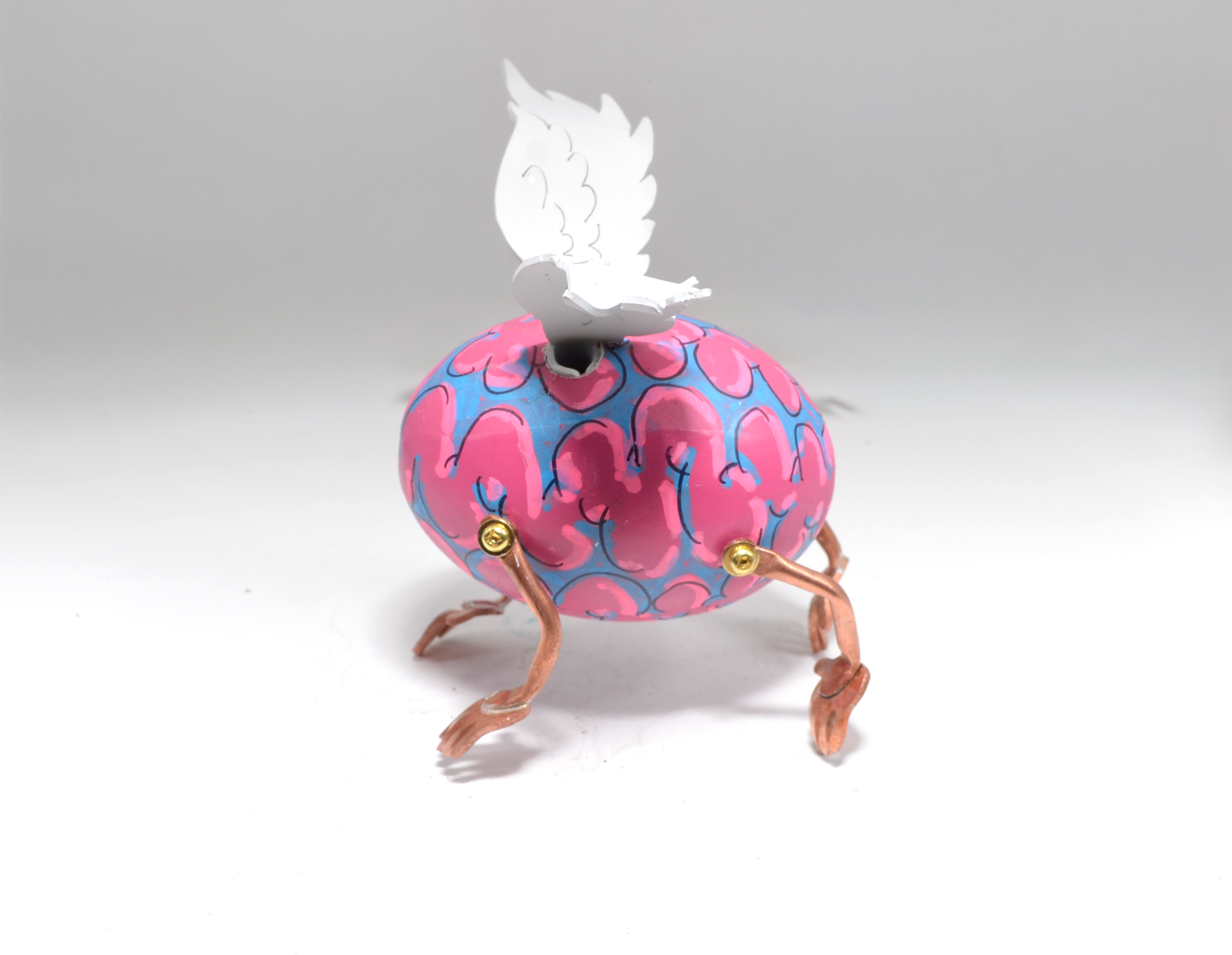
How does your creative practice allow you to restore (renew, return, reclaim, recover)?
“My creative practice is rooted in transformation—taking materials, objects, and ideas that already carry histories and giving them another life. I work extensively with reclaimed wood, salvaged materials, and found objects, allowing their previous lives to remain visible rather than erasing them. Restoration, for me, is not about returning something to exactly what it was; it is about honoring what it has been while allowing it to become something new.
That same idea extends to my sculptural practice. I am drawn to relics, talismans, ancient symbols, and objects that carry stories across generations. I rework these references through my own hands, often making them stranger, more playful, tactile, or interactive. The act of making becomes a way of recovering connections—to material, history, memory, and imagination.
My Primordial Eggs embody this process. They begin with an ancient image of an undefined, formless being and are transformed into brightly colored, articulated creatures that invite interaction. They don't return to an original form; they evolve into something else. For me, that is a powerful form of restoration: reclaiming the freedom to change, to remain unfinished, and to decide for ourselves what we can become.
Handmaking gives me a way to slow down and pay attention—to repair, reinterpret, and reconnect. I see restoration not as erasing damage or returning to the past, but as carrying what is valuable forward and making room for something new.”
As a queer+, artist, what do you see can be, needs to be, or cannot be restored?
“As a queer artist, I think restoration is complicated. Some things can be repaired, reclaimed, and carried forward. Other things cannot—and perhaps should not be restored to what they once were.
I think about restoration through material. Much of my work uses salvaged wood, reclaimed objects, and materials that already carry evidence of another life. I don't try to erase those histories. A crack, scar, knot, or alteration becomes part of the object's identity. Restoration can mean honoring what survived while allowing it to become something different.
I think the same is true of queer history and identity. There are lineages that need to be recovered—stories, relationships, creative practices, and ways of living that have been erased, hidden, or pushed to the margins. There is value in finding those fragments and bringing them back into visibility. But I don't believe queer people need to restore themselves to some imagined original version of who we were supposed to be. There may be no original form to return to.
What needs to be restored is the ability to belong, to be visible, to create, to love, and to imagine a future without having to justify our existence.
What cannot be restored is innocence about the histories of exclusion and violence that have shaped our communities. We cannot undo what has been lost. We cannot make the past unhappen. But we can refuse to let loss be the end of the story.”
Photographs Courtesy of the Artist
Anything else you would like to share about this work? This can be an important part of the process, sourcing materials, or research.
“Multiple Primordial Eggs will also be included in my upcoming exhibition Legend, Myth, Lore at NOMA Gallery in Frederick, Maryland. The exhibition explores myth and contemporary life as we navigate an era of accelerated change, where artificial intelligence, global pandemics, political instability, technological disruption, and shifting social norms have made permanence feel increasingly elusive.
Within this body of work, the Primordial Eggs respond to that instability by refusing to remain contained. Their articulated arms reach beyond their small wooden bodies, cross boundaries, gesture toward the viewer, and create their own systems of interaction. They are simultaneously playful and unsettling—bright, colorful objects that suggest both anxiety and liberation.
The eggs began with my research into Dijiang/Hundun, the ancient Chinese embodiment of primordial, formless chaos. I was particularly drawn to the idea of a being that exists before definition: without a face, identity, or prescribed form. I reinterpret that concept through handmade wooden eggs, decorated with brain-like patterns and articulated limbs. Rather than illustrating the mythology literally, I use it as a starting point for thinking about consciousness, uncertainty, transformation, and the human desire to make meaning.”